Posts

The Neophyte's Journey…
Image
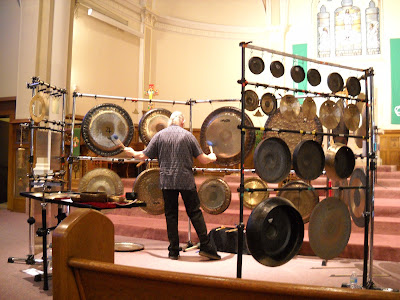
I've owned and played Gongs (and related metals) for 40 years now, and it's been quite a journey. I've played Gongs in all types of musical situations: hard rock bands, prog rock bands, classical music, improv music, meditation, Yoga, and many others, both live and in the recording studio. Along the way I've collected around 70 Gongs from around the world, as well as over 100+ bells, bowls, cymbals, plates, and other resonant metals. And it's all about the journey. The journey has no end… This journey, even after all this time, still surprises me. I keep discovering new sounds, new techniques, new ideas each time I play. What I once thought of as a concise and codified musical experience has revealed itself to me to be unlimited. Playing the Gong is like playing an ever opening flower. neophyte noun   neo · phyte      \ ˈ nē-ə- ˌ fīt\ : a person who has just started learning or doing something After all this time, and countless concerts and musical sess...

No, You Are Not A Gong Master

This came across my radar recently, someone was posting about being a Gong Master after having taken a class with a well known person in the Gong community.  I'm sorry, you studied for a weekend, or a week, with someone and now you refer to yourself as a master ? Let's look at a few of the definitions of master: master noun  |  mas•ter  |  \'mas-t ər\ Definition of  MASTER 1 c   :   a worker or artisan qualified to teach apprentices d  (1)   :   an artist, performer, or player of consummate skill  (2)   :   a great figure of the past (as in science or art) whose work serves as a model or ideal Unfortunately, the definitions do not delve further into what it takes to become a master. They do not refer to the years, even decades, or practice and work that goes into mastering something. Nor do they speak of the devotion needed. Let us look at artists considered to be masters : Mozart, Beet...

Mail Call: What Gong Should I Buy?

Image
Two typical questions I get from people are: I want to get a Gong. Which one should I get? and I have a _____ Gong and a _____ Gong.  What should I get to go with them? Two good questions with no easy answer. There is no starter Gong , or add on Gong out there, so it's all a matter of context and personal choice. The first thing is context: do you want it for a rock band? A classical thing? Or a meditation thing?  In all 3 of these situations I would recommend a Symphonic/Chau type Gong between 24" and 32" as a good place to start. This will give you a big, full sound and fit a lot of musical situations. If you don't need as much volume, and perhaps something easier to carry, a 22" to 28" Wind Gong might suit your needs. A 22" fits in a standard cymbal bag and has a fairly full sound. But as always, what Gong resonates with you? If possible, play as many different types and sizes as you can before you make a decision. It's mo...

Mail Call: Breaking In Your New Gong

Image
Another question I have received is,  “Do I need to break in my new Gong?”  This is a good question. From my own experience, there is no need to break in a Gong before you start playing it, but, a Gong will go through a period of breaking in as the sound and metal settles.  This breaking in has 3 distinct phases: 1) - The metal settling. The bronze, or nickel-silver, that Gongs are made of, has a crystalline structure that tends to settle over time. According to Billy Zildjian, from the SABIAN cymbal company, talking about cymbals, “The internal molecular structure has a tendency to float within the metal of the cymbal. After some time the molecules actually begin to bind together as the metal settles.” (from Modern Drummer magazine, November 1983) This is thought to change both the tone and the feel of the metal. There is also some belief that playing the cymbal or Gong helps the metal settle. There are various stories of jazz drummers, most notably Elvin ...

Mail Call: Playing Small places & Mallet Advice

Image
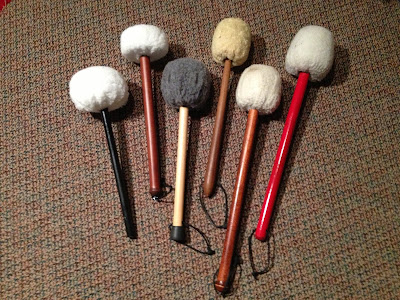
I get a lot of e-mail with questions from drummers & Gongers about a wide range of things. Today I'd like to address a question I received yesterday: I am seeking some advice with mallets.  A few of the yoga studios I play at are smallish, they fit about 20 people mat to mat and have short ceilings.  The gongs end up becoming intense in such small spaces, almost too intense.      Do you have any advice as to what kind of mallet might be a soft, gentle, roller that could work better than the paiste mallets in such small spaces? I have a few different kinds (paiste, chinese, and some z brand mallets) but they still get pretty big and tingy.  any suggestions on how to handle these spaces either with mallets or otherwise?  First thing: it's rarely about the mallets. It's all about the technique. I regularly play places that hold from 20 people, to places that can hold 100. In all situations I use the same instruments and the same...

Time Shifting

Image
Time does not exist—this is a new quantum physics theory that is gaining in popularity:  There is no past.  There is no future.  There is just the present moment, which is all possible moments existing at once. Thus by changing our perception, we can change our view of time . If you've worked with Gongs/Bowls/Bells for long enough, you know that the resulting vibrational fields can alter your perception of time. How often have you played for an hour and you, and/or your participants, have remarked that it seemed like 10 minutes? I hear this a lot from people at my sessions.  Another scenario is people who feel like they're been gone for hours, even though it was just 1 hour. Time shifting . Changing your perception of what time is and where it is, or perhaps more accurately, where you are in relation to time at any given moment. Yogis and Spiritual Masters talk about enlightenment, or nirvana, where you merge with the oneness of all. This is the po...

The Importance Of Doing Your Research

Image
Recently there was a whole Facebok thread started by Dr. Mitch Nur. It was all about the validity of the often used quote: “Sound will be the medicine of the future.” This has been attributed to the famous sleeping prophet , Edgar Cayce (1877-1945). Cayce was famous for being able to give readings to people, and also answer various questions on things such as the future, Atlantis, reincarnation, etc. while in a trance. Much of what he said was written down by a stenographer and is available in various books or on the web. You can check things out on the official Cayce website, Association for Research and Enlightenment (A.R.E.) .  Edgar Cayce Now Mitch was questioning the validity of this quote and wrote to A.R.E. to ask if they could find it in their archives and verify it. There reply to him was: "Good Morning: thank you for your inquiry. I have researched the Edgar Cayce Readings and can find no reference to the quote on 'Sound will be the medicine of the...