Posts

The Importance of Ritual

Image
ritual noun rit·u·al 1 :   the established form for a ceremony; specifically :   the order of words prescribed for a religious ceremony 2 a :   ritual observance; specifically :   a system of rites  b :   a ceremonial act or action  c :   an act or series of acts regularly repeated in a set precise manner (from Merriam-Webster) Ritual. We see them all around us, some conspicuous, some slightly obscured. We see them in our religions, in our businesses, in our clubs and sports. Some of us may even have rituals that we do.  A good example of a ritual is in sports. A lot of athletes go through some sort of pre-game ritual. Maybe they listen to their favorite inspiring music, or meditate, or have talisman/lucky charms with them. They may get dressed in exactly the same way each time, for example, always put the left sock on first, ke...
The Essence and Power of Tradition

Image
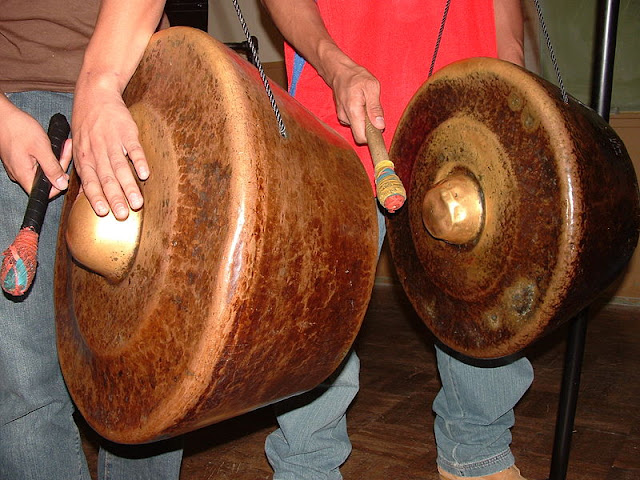
The instruments we play—Gongs, Bowls, Bells—come with deep lineage and and long lasting traditions. There is power there. There is magic. There is superstition. And there is also a lot of bull shit. It's almost 2017, and as modern and developed as mankind has become, it has also lost touch with so much rich and varied tradition handed down over the ages. In many ways we have become so blind in our quest for the future, that we have forgotten the past. Philippine Gong tradition Here's a test: Go out in your neighborhood, or your local park. How many tree species can you actually identify and name, besides oaks and maples? The same thing goes for both flowers and weeds. It wasn't that long ago that people were much more connected with their surroundings and could identify them. In many cases it was a life of death matter to know your plants: which ones are safe to eat, which ones will kill you.   Do you know that there are a lot of city kids who have never seen a...

It's A Gong World After All

Image
I remember when I first started playing Gongs, other than Paiste, there wasn't much available. Zildjian made a few Turkish style ones. UFIP, in Italy, made some, but they were often difficult to find. And China was still an enemy of the USA, so real Chinese Gongs were practically nonexistent. For most Asian Gongs, you had to know someone who knew someone; or you had to know an Asian American who had connections back in the mother country. And if you were fortunate enough to live on the West Coast, where Asian immigrants imported a lot of musical instruments from their homelands; or to be a scholar/researcher/word traveler who could go to Asia, you could pick them up yourself. 40 years ago I was buying buying bells at Pier One stores, because they actually carried a nice selection of bells from India. Then World Market (before they became just a food/wine/furniture retailer) came around and they had drums, bells, Gongs, and ethnic percussion. I got some of my 1st G...

How Should You Face?

Image
Today's blog comes from   this week's  mail box. A question was asked,  “Although I originally learned and observe others playing the gong with their back to receivers, gong facing them, I've changed that so that I can occasionally look up to check on my students. What is your opinion?”   What way to face? I usually have my Gongs behind me and face away from the people. As a drummer, this just evolved out of having my Gongs behind my drum set years ago. I still set up that way today, partly out of habit, partly out of practicality, especially in a concert situation.  Circa 1980: drums in front, Gongs in back. Circa 2015: drum in front, Gongs in back. So naturally, in a Gong Meditation Session, I usually have the Gongs in the back, with Bells and Bowls in the front. I t's more of a circular set up where I move around and face different ways, depending on what instruments I'm playing.  But if I'm working with a Yoga teacher, or some...

The Journey is the Destination

Image
Today, more musings on questions   recently  asked. This time, I look at what we really do. Someone was asking, “Is there a goal to our playing?” Another way to look at it is, should we look towards an endpoint when we are playing? This is an interesting question. In the modern world, we are brought up in an atmosphere of winning is everything . It seems all our activities have as their purpose, getting better grades, making more money, acquiring more things. But in our quest for all this, we have lost our direction and veered off the path. We are wandering around in the weeds of material gain, looking for a destination. The important thing to realize when we play the Gongs/Bowls/Bells, is that there is no destination .  The journey itself is the destination.   It's important to be in the moment, to be fully present when playing. Too often we can be sidetracked by thinking ahead, thinking about some imagined ending, or result. But by bei...

How Should You Store Your Gongs?

Image
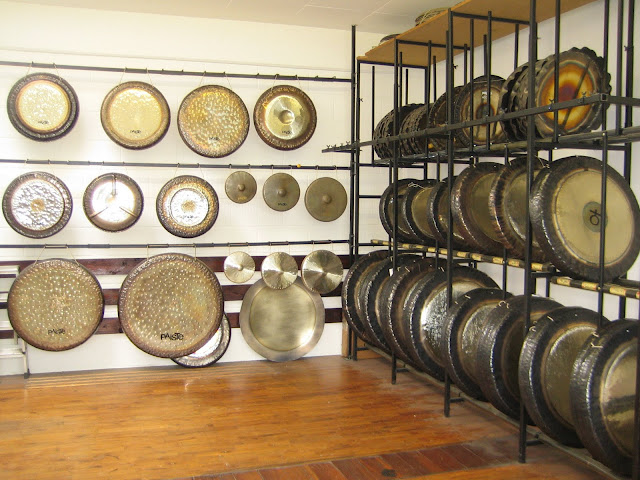
Today's blog comes from   FaceBook, where someone  posted asking about how to store your Gongs. This is a great question that I haven't really seen covered before. The prevailing thought that I have seen from people is to store them horizontally, laying them on their face, stacking multiple Gongs on top/inside each other. This is perfectly fine, as long as you protect the face of each Gong with carpet/blankets/etc. Many people will say not to store them vertically on their edge because they can become damaged. I have to say that this is incorrect . I have around 200 Gongs and cymbals, and in over 40+ year of being a percussionist, I have always stored them vertically on their edge. In that time I have not had any instrument become damaged from being stored on the edge! Gravity alone will not damage a Gong stored on its edge! The only way you will damage a Gong stored on its edge is if you purposely push down on it against the floor, drop it, store something heavy on ...

Working With Instruments You Don't Like

I hand pick most of my instruments. I play through a lot of different ones to find the ones that will work for me. But sometimes I buy things online, based on sound files/videos, or just a general knowledge of what it will most likely sound like.  In both cases,  sometimes   when I get the instrument home, and start playing it, there is a sense of disappointment, or a feeling of “That doesn't sound like I thought it would.” This can often be attributed to the changing acoustics of different rooms, or even my own changing mood from day to day. But sometimes things just don't sound the way I had hoped they would. What's a person to do? A first reaction might be to dump it, sell it online and hopefully recoup all, or most, of what I spent for it. But a better thing to do is to live with it, to work with it, to give it time to sink in.  As humans, we are most attuned to familiarity.  We like familiar music, clothes, food, etc. Often, something differe...