Posts

Finding Your Voice

Image
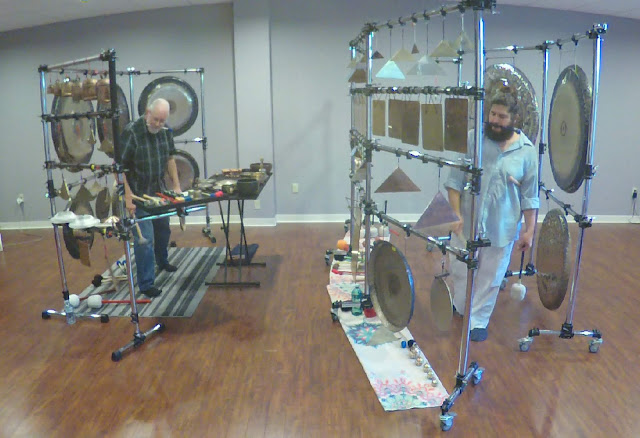
No one picks up an instrument for the first time and produces a fully formed, unique style of playing. Often our first moves are tentative, hesitant, and not quite understood by ourselves. To play Gongs, Bowls, and Bells presents us with unlimited possibilities for sounds, but to the novice, most of these sounds are unknown. And even if they are known, the novice has not yet developed the ear, the sense of touch, the required skills to makes many of the sounds they hear others produce. Michael Bettine (L) & Mike Tamburo (R) finding their own voices So where do you start? There are 2 basic ways to start: 1 - Explore your instruments. Makes sounds, take chances, see what both you and the instrument are capable of. Do this in private so that there is no need to feel embarrassed or inadequate. This is a time of learning. Keep track of the sounds you make and how you made them, because you want to be able to repeat them in the future.  Also keep track of what...

Adjusting Your Sound To Fit The Space

Image
I have seen/heard some people who seem to play their Gongs at the same intense volume no matter where they are playing. Small room, medium room, large room—they play the same. This also goes for the type of room, whether it's a very lively reverberant space; or a dry, dead sounding one—they play the same. I attribute this to inexperience, and perhaps not understanding the nature of sound and creating music . I've played thousands of different spaces over the years, and the most important thing I have found, is to learn how to judge each room/venue that you play in for its acoustic properties, and how your instruments will react in there. Now I'm talking mostly about playing with no mics or sound amplification. Using a sound system changes things a lot. But in a completely acoustic environment, you need to be responsible for your sound . This is especially true if you want your listeners to have a great experience. You need to be responsible for your sound Tonight,...

Silence As A Tool

Image
I have to thank my good friend, Kenny Kolter, for the idea for today's post. We were talking about using silence as a tool . It's an interesting concept that I fear many people making music, especially Gong & Bowl players, don't understand. Into The Realm Of Silence Silence is remarkable in its ability to actually reveal sound. So much music today, and much of the Gong playing I hear, is a non-stop barrage of sound. In that capacity, it's virtually impossible to distinguish individual sounds, to really hear what is going on. The human mind has the remarkable ability to shut off unrelenting sounds, or noise, after a short time.  Invite silence into your playing. Photo © Michael Bettine Think of the street construction in front of your house. At first you find it irritating and loud, but after a while, your mind tunes it out and you barely notice it anymore. The same with the neighbor's lawn mower, busy street traffic, or living by an airport. All thes...

This Is Not A Competition

Image
It always intrigues me how artists often talk like they are in some sort of completion with other artists. “If only I was as good as X,” or, “I've really got X beat with what I'm doing now.” This type of thinking, whether feeling less than, or better than someone else, is really counter productive to our artistic endeavors.  The funny thing is, if you are trying to keep up with someone else, they will always be a step or two ahead of you. And if you feel that you are ahead of someone else, they may shift direction and leave you sitting there by yourself. Competition? Competition. What for? What is the real goal? The only competition we need is with ourselves. The challenge should not be to be better than someone else, but to be better at what we do each day. The arts are not sports. There are no winners or losers. There is no real definition of winning . I used to think this way, but it's a dead end where you end up spending too much time looking over ...

What's The Best Gong To Buy?

Image
This week we go to the mail box again. This time from Rafael in Brazil: Can I ask you a question, please? One interested person that wants a gong for Yoga sessions asked what is the ideal size for a gong in that situation? We have the 32" Chiron, but is it too big? What should be considered? Do you think a 24" is too small? 32” is a great size because it puts out a lot of vibrations, yet it is still easily carried. I use 2-32” Paiste Gongs, a Symphonic and a Sound Creation Earth.  The Chiron is a great Gong and I know a lot of people who use that one.  I  always recommend a Gong 24” or larger for yoga or meditation, especially if it’s the only gong being used. A  24” still puts out a lot of sound & vibrations. Smaller Gongs just don't seem to have the enough vibrational power on their own. The one  exception would be the 22" Paiste Accent Gong, which puts out a lot of sound for its size. My current Paiste set up is the 2-32” Gongs, a 28” Jupiter, 26” P...

Is Your Music Pre-Ordered, Or Is It Improvised?

Image
Today's blog subject comes from the mailbag. Someone who is new to presenting sound sessions recently asked: “So the question is, do you have a certain order for sound sessions, or is it all improv?” For me, it’s a combination of both. While each night is improvised, there are certain musical elements that often reoccur from session to session—things like rhythms, melodies, specific sounds made with specific instruments.  I choose from these small gestures for each performance. The actual choosing is an intuitive process. It's not so much a  conscious, “I will play this Gong right now,” as much as I feel compelled to move to some other instrument, rhythm, or melody.  I look at what I do as one continuous forward motion (from start to finish) and I will choose various elements as I move along. The order I play things in varies, and not everything gets played every time (for example, I've had people tell me after a session that I didn't play something—th...

Ways of Hearing

Image
Hearing is a strange thing. So often we listen to things—conversations, traffic, music, etc—but we don't hear  them. We have become so used to having sounds in the background that we don't really notice them at all. And this especially happens to music. It's playing everywhere, 24/7—at the market, in our car, at the office, at home, etc. We have become so used to this, that when we consciously play music from CDs or downloads, we often use it in the background. When was the last time you just sat and listened to music and nothing else? Just sat and really listened? Even at live concerts, people are often so busy checking their phones, texting, taking photos and video; that the 'live' music becomes secondary, just another background. Whatever happened to listening to music? Exercise #1 - Sit in a quiet room, make yourself comfortable, and play your favorite recording/s. To help with distractions, turn out the lights if it's nighttime, or cover your eye...